Introduction
Imagine typing a simple sentence in prompt:

A few minutes later, AI generates and gives the image that never existed before.
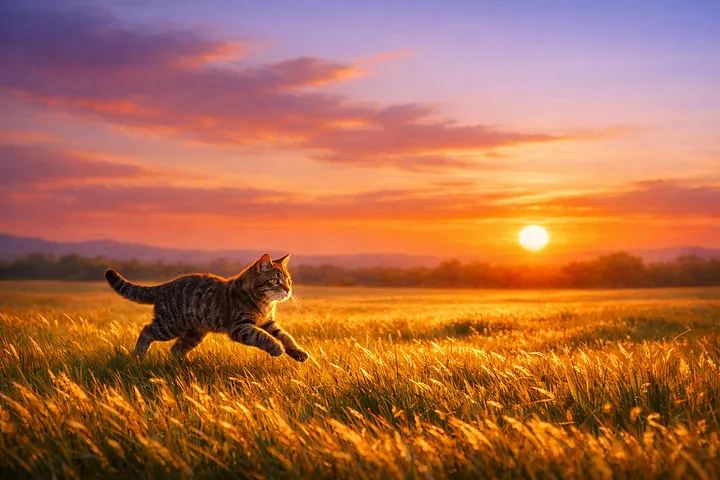
“A Cat Running Across the Field in Sunset”
The Cat looks real. The grass looks natural. The lighting matches the sunrise. Everything looks perfect.
How does it do?
Does it search the internet for the image? Does it combine photos already took by photographers?
The answer is “no”
The AI image generators create images by learning the relationship between words and visual concepts. They are trained on millions and millions of image collection along with the description and learn from them. Once learned they use mathematical and machine learning to generate new pictures pixel by pixel.
To understand in detail, let’s start with the basics:
What is a Digital Image?
How do humans look at an image, when we look at an image, we see people, objects, animals, colors and scenery. But computers does not look images like we do. The see it as numbers.
Digital image is made of tiny squares which we call as “pixels”
Each pixel contains information about colors. Most image the standard three color channels:
- Red (R)
- Green (G)
- Blue (B)
For example :
- Red = (255,0,0)
- Green = (0,255,0)
- Blue = (0,0,255)
By combining these three colors, computers can generate million of colors.
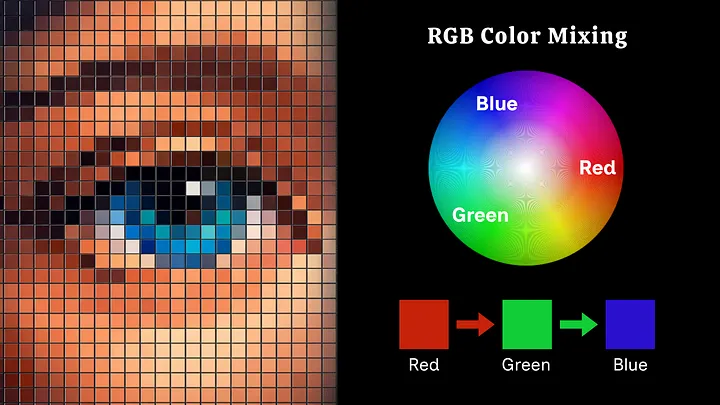
A 1024 x 1024 image contains more than one million pixels. To a computer it is a large grid that contains millions of numerical values. AI does not simply generate the clouds, sky, and sunset. It generate numbers that eventually turn into a image.
How AI Learns
Think of how a child learns. A child sees many dogs, cats, cars, and more in daily life. Over time, they notice patterns — four legs, fur, wheels — and learn to recognize them.
AI learns in similar way.
AI is trained with millions or billions of images like dogs, cats, mountains, water, cars and more.
The model looks for recurring shapes, textures, and proportions. Overtime it learns the patterns that help to identify and differentiate one object from another.
For example :
- For dogs — it may learn fur patterns, ears shape, tails
- For cars — it may learn windows, headlights, wheels
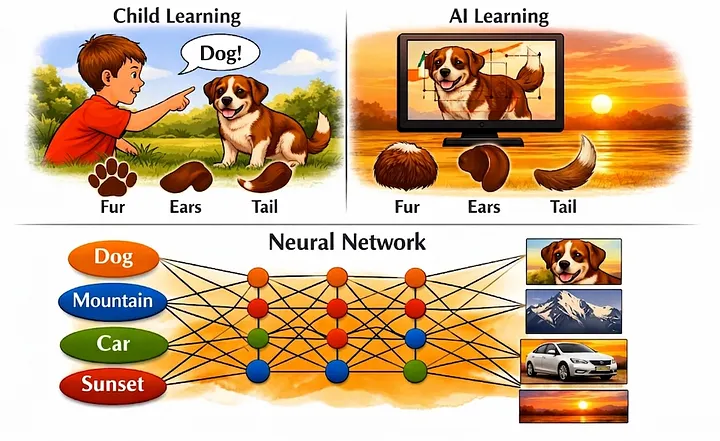
The model is not only trained with images, we give description along with the images. If not, it has no way of knowing what those images means. If we provide a photo of snow-covered mountains, we also give the caption “Mountains during winter.”
By seeing both the images and description, AI begins to connect the words with the features.
It will understand the word “dog” means it has certain shapes and features, the word “mountain” means rocky landscape and terrain, the word “sunset” means it will have warm colors and lighting.
After processing huge amount of data, the model understand how language relates to visuals. The way the system learns these relationship is what we call a “Neural Network”
Diffusion Models:
Most modern image generations use the technique known as diffusion. The idea might look a bit unusual to you. Researchers discovered training a model to remove noise will eventually create a new image.
What is Noise?
It is a random visual information. Imagine the static that appears on an television with no signal. The TV contains pixels, but they do not have any meaningful objects. Everything will look random. There are no shapes, people, animals or any objects. Just Static visual chaos.
Researchers found that by gradually adding noise to an image, the image will transform any picture into randomness.
The training begins with real images. Researchers gradually add noise step by step to an image until it becomes unrecognizable.
The interesting thing is AI observed this process and learnt to reverse it.
The AI task is to predict how to move from a noisy image into more clear version. By practicing on millions of examples, the model becomes good and learns how shapes, colors, texture, lighting and objects from noisy data.
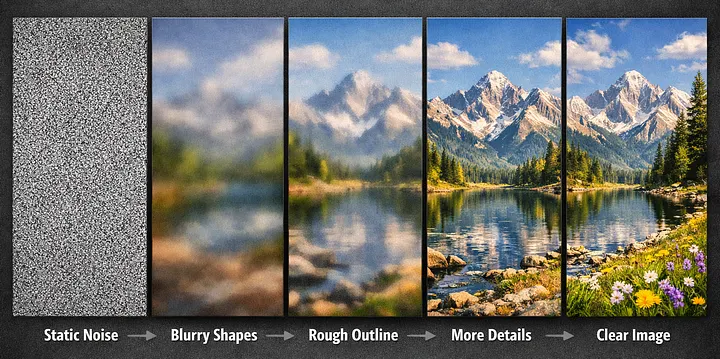
From Noise to Clarity
Once the AI learns how to transform from noisy images to clear images. Now, instead of starting to use real image and then add noise. AI starts with noise and gradually remove it. The process continues until the clear image is formed.
This is how the modern AI image generation creates the image.
Let us get back to our example to understand this in a better way
“A cat running across the field in sunset”
Before generating the image, AI will understand the meaning of the sentence. The given prompt is converted into mathematical representations and understand its meaning.
The model identifies the important words from the text
- Cat
- Field
- Sunset
It also understands the relationship between these words.
The cat belongs in the field. The sunset affects the lighting and atmosphere of the entire scene. These relationship turns into a instruction to the AI which used to generate the process.
Starting from Random Noise:
The image generation process begins with a completely random image. At first, there is no cat — no field — no sunset. Just a pure random pixels that fills the image.
Now, the AI will begin to refine the random image according to the given prompt.
Building the Scene:
The first stage is the model focuses on overall scene of the prompt. It decides where major elements should appear.
One region will become the cat, another will become the sky and another will become the field.
The image will be still blurry but the overall structure on the image is being formed.
Forming Objects:
As the process continues, major objects becomes clearer. The Cat’s body gets the shape, The field becomes recognizable & the horizon line separates the sky and land.
Large random noise will eventually transform into identifiable objects. The image starts to look like the prompt rather than the random noise.
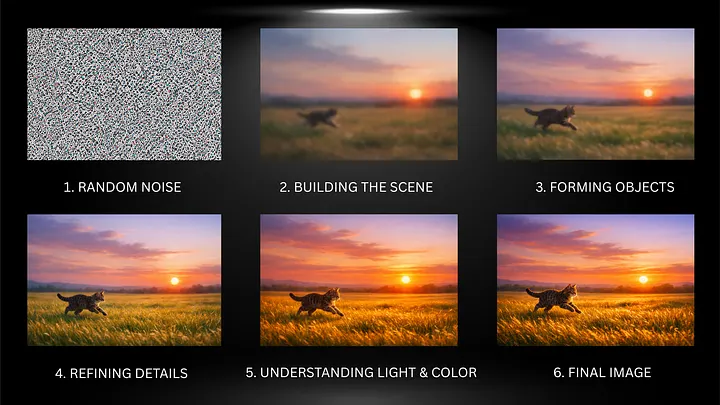
Step-By-Step Process of Image Generation.
Refining Details:
Once the major objects and structures are in place, the model focuses on details.
Individual blades of grass becomes visible, the field gains the depth & variation, Clouds form shapes in the sky.
Each step of generation adds new visual information which helps to increases the reality of the image.
Understanding Light and Color:
Whatever the objects and structure are generate, the reason AI-generated images looks realistic is that it learned about how lights behaves.
As the prompt mentioned sunset, the model expects:
- Warm orange tones
- Long shadows
- Soft lighting
- Reflections from the setting sun
These effects are applied throughout the entire image to make it realistic.
The Final Image:
At the end of process, the model performs the final refinements.
Edges becomes sharper, texture becomes clearer, colors become more balanced, small imperfections are corrected.
After dozens of denoising steps, the image reaches its final form. What it has started as random noise image has become more detailed picture matching the prompts description.
When you generate the same prompt multiple times, you get different results. This is because each generation begins with a different random noise pattern. The starting randomness noise image defines the final outcome. So, multiple unique images can be created from the same prompt.
Future of AI Image generation:
Even though modern image generators are really impressive they sometimes make mistakes like adding extra fingers, incorrect text, strange reflections and more.
As the models improve, these errors will reduce and future system may generate:
- Higher resolution images
- More accurate text
- Better understanding of complex scenes
- Greater consistency between images